Select your preferred calculation method to find out your pregnancy week.

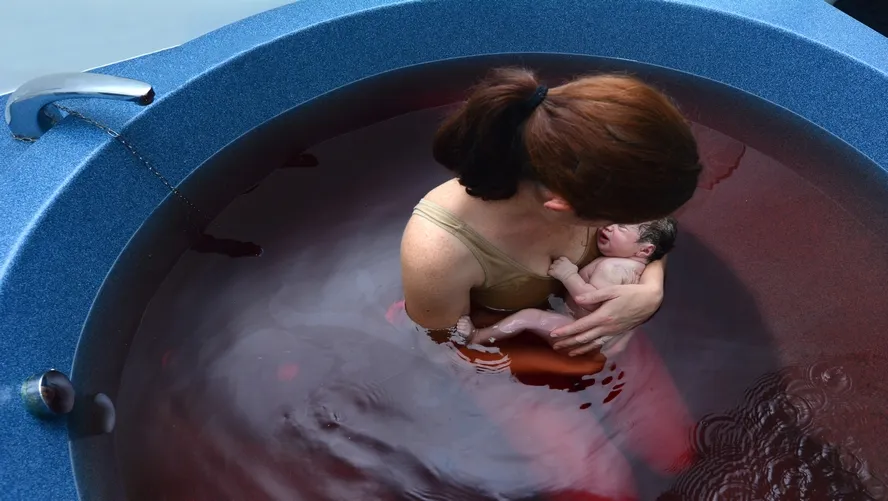
The increasing variety of childbirth methods today is leading expectant mothers to explore alternative options. Water birth, which has become popular in recent years, is one of them. Water birth is a method of childbirth that takes place away from the delivery room, where the mother experiences less pain and requires less medical intervention. When the mother's due date arrives, she gives birth in a sterile pool containing water at a specific temperature. Water births take place under the supervision of doctors and nurses in hospitals or maternity clinics that offer this option. You can continue reading the article for more detailed information on "What is water birth?" and "How is water birth performed?".
What is water birth?
Water birth is a type of normal childbirth where all or most of the labor takes place in water. The expectant mother is positioned in a tub filled with water at 37 degrees Celsius (37 degrees Fahrenheit) after labor begins, covering her abdomen. Since normal body temperature is 37 degrees, the water temperature is adjusted accordingly to maintain the ideal temperature. The water temperature can change throughout labor due to amniotic fluid, urine, and other substances. To prevent fluctuations, the water temperature is constantly monitored. While the entire birth can take place in the tub, the mother may be moved to a delivery table during labor. Certain procedures must be followed for a water birth to occur.
The requirements for a water birth are as follows:- The expectant mother requests a water birth.
- Doctor approves water birth
- Pregnancy being in a low-risk group
- Pregnancy between 37-42 weeks
- The normal estimated baby weight is 2500-4000 grams.
- The baby's heart rate is normal.
- The expectant mother should not be overweight to the point of obesity.
How is a water birth performed?
For expectant mothers planning a water birth, one of the most frequently asked questions is undoubtedly, "How is a water birth performed?" A water birth involves the birth taking place in a bathtub or inflatable pool filled with water. This type of bathtub birth is particularly preferred by expectant mothers who fear natural childbirth. The process begins when a pregnant woman, whose due date has arrived, visits a hospital or birthing clinic that offers water birth facilities. Alternatively, a water birth can also take place at home, provided the necessary conditions are met.
The conditions necessary for a water birth to occur are as follows:The equipment needed for water birth can be listed as follows:
- Waterproof Doppler or electronic fetal monitoring devices
- Standard, filtered tap water
- Shoulder-length gloves
- Waterproof clothing and protective goggles used by healthcare professionals assisting with childbirth.
- Neonatal radiant heater (a device that keeps the baby at the same temperature as in the mother's womb) and resuscitation (cardiac massage and respiratory support) equipment for the baby.
- Items for expectant mothers include towels, blankets, birthing sets, etc.
What are the advantages of water birth?
Water birth is a preferred method for expectant mothers due to its many advantages. If the baby is born in water, this can help the mother and baby bond more quickly after birth. Furthermore, the baby, having spent nine months in the water in the mother's womb, adapts to the new world more quickly by being born under similar conditions. One of the biggest advantages of water birth is the use of warm water. Warm water, which has been used in normal births since ancient times, has a relaxing effect on vaginal muscles. The warm water used in water birth provides relaxation in the perineum, vagina, and cervix, helping to reduce labor pains. Thanks to the buoyancy of the water, the mother can move more easily and does not experience much difficulty during pushing. Also, the relaxing effect of warm water can release endorphins in the body, making the mother feel happier and more peaceful. Water birth also reduces the need for episiotomy (surgical incisions in the vagina to facilitate delivery).
In general, the advantages of water birth can be listed as follows:- It can significantly suppress the pain experienced until the time of childbirth.
- It can eliminate the need for epidural or spinal pain relievers.
- By enabling the mother to move quickly, it can shorten the duration of labor.
- It can reduce the effort and labor involved in childbirth.
- By increasing blood flow to the uterus, it can prevent the baby's heart rate from slowing down.
- Increased blood flow can help increase the amount of oxygen reaching both mother and baby.
- Vaginal tears may have been prevented.
- It can reduce the need for emergency cesarean sections that can occur during normal childbirth.
- Water can stimulate the nipple, thus accelerating milk production.
- Warm water can make the baby's birth canal more relaxed.
- Negative emotions such as fear, anxiety, and excitement felt during childbirth may decrease.
- Postpartum depression may be less common in some mothers.
- It can make childbirth a pleasant experience.
What are the risks of water birth?
Water birth is considered safe in most cases and may pose risks only in very rare instances. Any woman capable of a normal vaginal delivery can comfortably choose water birth. Although the risks of water birth are low, some undesirable situations can still occur.
Some of the risks of water birth include:- Mother or baby may get infected.
- Excessive vaginal bleeding may occur.
- It may be difficult to monitor the baby's heartbeat.
- The umbilical cord may break before the baby is taken out of the water.
- The baby's body temperature may be lower or higher than normal.
- The baby can swallow the bathwater.
- The baby may have difficulty breathing or may have seizures.
- The baby may develop shoulder dystocia (when the baby's shoulders get stuck after its head passes through the vagina).
These complications (side effects) are rare. What's important here is the healthcare facility and personnel where the water birth takes place. Choosing a doctor or nurse experienced and knowledgeable in water births, and ensuring the sterility of the materials used, are crucial for a healthy water birth experience. Experienced healthcare professionals minimize the risks of water birth.
Who cannot give birth in water?
While water birth is a safe and healthy method of childbirth, it is not suitable for everyone. Several factors may prevent a water birth.
In general, some of the conditions that prevent water birth are as follows:- Those under 17 or over 35 years of age
- Having diabetes, hypertension, and heart disease
- Being a carrier of HIV and Hepatitis virus
- Those who have genital herpes (cold sores)
- Those who have previously had a cesarean section
- The leakage of amniotic fluid before labor begins.
- The mother is experiencing excessive menstrual bleeding (menstrual cycle) at the normal time.
- Presence of twin or multiple pregnancy
- If the baby is going to be born prematurely
- If the baby entered the womb breech, rather than head first
- If the baby is heavier than normal
- If there is an existing infection
- If there is preeclampsia (pregnancy poisoning)
- The mother is using medication that may cause sedation (a semi-sleep state).
- Generally, expectant mothers who have reasons that prevent a normal delivery.
If you are planning a water birth, you can get detailed information by consulting your doctor who is monitoring your pregnancy . Choosing a healthcare facility that is experienced and trained in water births is crucial for a healthy birthing experience.
.jpg?lang=tr-TR&ext=.jpg)







 Make an Appointment
 E-Result
 Let Us Call You